First impression counts, and the interview room is where it matters most.
In order to boost your chances of getting hired, you need to make a very good first impression. You need to project a professional image, and your clothing is the most visible part of that projection before you say a single word.
Key Takeaways
- The rules for what not to wear differ slightly by industry, but the baseline standards for professionalism are consistent across almost all environments
- Visible undergarments, overly casual footwear, and clothing that exposes skin are the most common attire disqualifiers
- Strong cologne or perfume is a silent dealbreaker — many interviewers are sensitive to scents and will not say so directly
- Noisy or excessive jewelry draws attention away from your words and can undermine an otherwise strong interview
- Personal grooming is an entirely controllable variable — never neglect it before an interview
Remember that a lot of what you should wear depends on the industry you’re trying to get into. For conservative industries such as accounting, finance, and law, opt for a simple, formal look. For creative industries such as advertising and graphic design, you can dress more expressively — but the baseline is still intentional and polished, never casual or sloppy.
Specific Items and Behaviors to Avoid
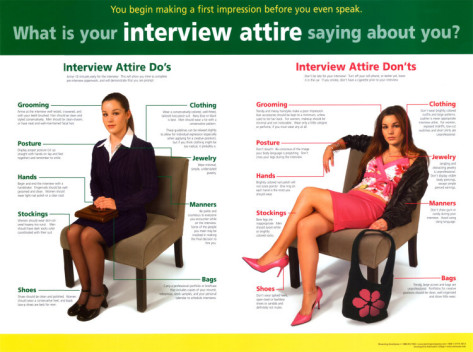
Do not wear flip-flops or sneakers. Unless you are specifically interviewing for a role where this is the stated norm (think: athletic brand, startup with a documented casual culture), open-toed or athletic footwear signals that you did not prepare for this meeting. Closed-toe, clean, polished shoes are the professional baseline.
Do not let undergarments show. This applies to bras, bra straps, briefs, and boxers that are exposed or visible through clothing. It does not matter whether they coordinate with your outfit — they should remain unseen. Check your outfit in natural light before the interview, not just indoors.
Do not wear shorts, overly tight jeans, mini-skirts, or low-rise pants. These items are casual by definition, and most interview settings interpret casual clothing as a signal that the candidate does not fully appreciate the stakes of the conversation. Well-fitted trousers, a professional skirt at or below the knee, or dress pants are the appropriate lower-body choices for almost every interview.
Do not wear blouses that expose cleavage or the belly. Revealing clothing shifts attention away from your qualifications and can make interviewers uncomfortable. A fitted, modest top in a neutral color projects competence and confidence.
Do not reveal tattoos or piercings unless you are confident the company has no policies against them. In conservative industries or companies, visible tattoos and facial piercings are still evaluated negatively by a significant percentage of hiring managers. Research the company’s culture before the interview. If in doubt, cover tattoos and remove non-ear piercings for the day.
Do not wear overpowering cologne or perfume. It can be a distraction, and many interviewers have genuine allergies or sensitivities to strong scents. You want the interviewer focused on what you are saying, not on the fragrance in the room. Opt for no fragrance, or at most a very subtle application.
Do not come with unkempt or dirty hair, or ungroomed facial hair. Clean, neat hair is a baseline expectation in any professional setting. For men, shaving or trimming facial hair neatly before an interview is standard — unkempt facial hair registers as a lack of preparation. For everyone, hair should be clean and arranged in a way that looks intentional.
Do not wear obnoxious or novelty ties. Men who wear ties should choose designs that are subtle, professional, and unlikely to provoke comment. A solid or subtly patterned tie in a conservative color — navy, burgundy, grey, or dark green — reads as polished. A novelty print or bold graphic tie shifts attention from your face to your chest and invites associations that have nothing to do with your professional competence.
Do not wear anything that dangles, clanks, or jingles. Large earrings, multiple bracelets, and chunky necklaces all produce distracting movement and sound. The rule: jewelry should be seen briefly and forgotten immediately. It should not be the thing people remember about your interview outfit.
What “Dressing With Purpose” Actually Means
Dressing for an interview is not about following arbitrary rules. It is about removing every visual distraction between you and the interviewer so that they can focus entirely on your qualifications, your communication, and your fit for the role. Every item you choose or avoid should serve that purpose.
The candidates who show up looking polished and appropriate signal — before they have answered a single question — that they understand professional norms, that they prepared carefully for this opportunity, and that they exercise good judgment. These are all qualities employers are trying to assess in the interview itself.
For a complete guide to what to wear by industry and attire type, see our guide on interview preparation.
Frequently Asked Questions
What are the biggest clothing mistakes to avoid in a job interview? The biggest clothing mistakes are wearing flip-flops or sneakers, showing visible undergarments, wearing shorts or very tight clothing, wearing blouses that expose cleavage or the midriff, and wearing overpowering cologne or perfume. Any of these signals that you did not take the opportunity seriously enough to dress appropriately.
Can I show tattoos or piercings in a job interview? It depends on the company’s culture and any stated policies. In conservative industries, it is safer to cover visible tattoos and remove facial piercings for the interview. In more casual or creative environments, modest expression is generally acceptable. When in doubt, err toward conservative and ask about the company’s policy once you have an offer.
What types of neckties are not appropriate for a job interview? Ties with novelty prints, cartoon characters, political statements, or large bold graphics are not appropriate for most interview settings. Choose a solid or subtly patterned tie in a conservative color like navy, burgundy, or grey. The goal is to look polished, not to make a personal statement with your accessories.
Does jewelry matter in a job interview? Yes — excessive or noisy jewelry is consistently cited by hiring managers as distracting. Avoid dangling earrings, large necklaces, multiple bracelets, or anything that makes noise when you move. A simple watch, small stud earrings, and a minimal necklace are appropriate for most interview environments.
Why does personal grooming matter in a job interview? Personal grooming signals attention to detail, respect for the process, and professional self-awareness. Unkempt hair, unshaven facial hair, dirty nails, or clothing with visible stains or wrinkles all send a negative signal before you have said a single word. Grooming is an entirely controllable variable — there is no good reason to leave it to chance.
Get 50 Interview Questions + Expert Answers — Free
Join thousands of job seekers who've used our free guide to land more interviews.
Next step for your job search
Pick one guide and keep momentum.
Jobiety Editorial Team
Our editorial team researches and tests every piece of career advice we publish. We draw on real hiring data, interviews with recruiters, and hands-on experience to give you guidance that works.