You know you are ready for a home based business, but how do you start? When you scout for home-based business ideas, do not base your decision solely on the potential income.
Key Takeaways
- Choosing a business aligned with genuine interest produces better long-term results than choosing purely on income potential.
- Separating business finances from personal finances from day one is non-negotiable for accurate bookkeeping and tax compliance.
- Legal requirements — registration, licences, insurance, zoning — must be verified before your first paying client, not after.
- The home environment must be assessed honestly: a busy family home may require creative solutions for a dedicated, distraction-free workspace.
- Training programmes and franchise agreements are legitimate shortcuts that can reduce the learning curve significantly for some business types.
Choose a business that you enjoy doing, or something that you have a strong interest in. Yes, income should be considered but it should not be the only deciding factor.
Starting your home based business may seem easy when you first think about it, but in reality it involves a lot of preparation and discipline. To ease some of the challenges that come with setting up a home business, some entrepreneurs actually undergo a training programme or obtain a franchise or licensing agreement.
You also need to ensure that your home based business costs and expenses are separate from your personal ones. This means coming up with a good system to track your finances from the very beginning.
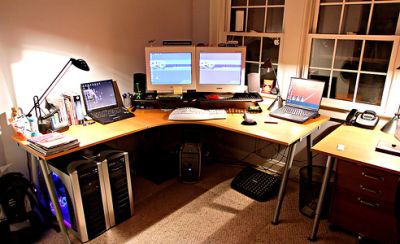
What kind of home environment will you be working in? Do you live alone or do you live with a big family? You need to dedicate a working space that is free of distractions. Choose a workstation in your house that does not have high human traffic.
Listed below are five of the most common types of home based business:
-
Desktop publishing. You can offer your publishing services — newsletters, marketing collaterals, and so on — to your network of former colleagues and acquaintances. Word of mouth will soon spread and before you know it, the quality of work will speak for itself. You can also offer consulting or advisory services for marketing and promotion.
-
Technical Support. Big companies have the budget for permanent technical support staff, but small companies do not. This enables you to target the technical demands of small and medium enterprises. Make sure you keep your prices affordable to your target market.
-
Property Management. This pertains to many services you can offer to households looking to maintain their properties. Start with a small number of services and grow your business as you reach more customers.
-
Online Merchants. With today’s technology enabling individuals to buy online in a more convenient, safer, and faster way, online sellers are reaping from these benefits too. Choose products with a high inventory turnover.
-
Virtual Support. Companies nowadays choose to outsource some of their tasks and you can use this as your main service. From administrative work to customer service tasks, you can offer these to businesses of all sizes.
The Pre-Launch Checklist
Moving from idea to revenue requires working through a set of practical tasks. Here is a structured pre-launch checklist for home business owners.
Financial preparation. Before launching, calculate your personal monthly expenses and identify the monthly revenue your business needs to generate for you to operate without financial stress. This is your break-even target. Then work backward: how many clients or sales at your intended price does that require per month? Is that number realistic given your market and available time? If the number feels impossible in the first three to six months, you may need a financial cushion (savings, a part-time job, or a supportive partner) to sustain you during the ramp-up period.
Separately, research your startup costs honestly. Many home business costs are lower than expected, but they do exist: equipment upgrades, website development, business cards, insurance, licencing fees, and software subscriptions add up. Know your total launch investment before you start spending.
Legal and regulatory preparation. Every home business is subject to laws and regulations that vary by location and business type. At minimum, research:
- Business registration: Is your business a sole trader, LLC, or other structure? What registration is required?
- Licences and permits: Does your service type require a licence? Food businesses, childcare, healthcare services, and financial services all have licensing requirements.
- Zoning laws: Some residential areas prohibit certain types of commercial activity. Check your local zoning ordinances — this is especially relevant if clients will visit your home.
- Homeowners association (HOA) or tenancy agreement: Check whether commercial activity from home is permitted under your housing agreement.
Insurance review. Your standard homeowners or renters insurance almost certainly does not cover business equipment, liability for client injuries on your premises, or professional liability for errors in your work. Contact your insurer to discuss a home business endorsement, or obtain a separate business insurance policy. The cost is typically modest — $300–$1,000 per year depending on business type — and the protection is essential.
Workspace setup. A dedicated workspace with a door that closes is ideal. If this is not possible, establish a clear physical boundary and a defined schedule during which the space functions as office space. The importance of this cannot be overstated — working from a sofa in a shared living area is a reliable path to poor productivity and blurred work-life boundaries.
Market validation before launch. Before you spend money on anything, confirm that people will pay for what you plan to offer. Have 15–20 honest conversations with potential customers. Describe your service and the price, then ask directly: “Would you pay for this?” and “Would you pay that price?” Genuine willingness to pay is different from polite interest — push past the social courtesy and look for the people who say “yes, when can you start?”
There really is no strict formula for a successful home based business — use your creativity in coming up with a great product or service, but anchor it in careful preparation.
For practical tips on the day-to-day reality of working from home, see: Do’s and Don’ts of Working From Home
Frequently Asked Questions
What do I need to do legally before starting a home-based business?
At minimum, you should register your business name (if trading under a name other than your own), check whether your business type requires a licence or permit, verify your homeowners association or rental agreement allows home-based commercial activity, and check local zoning laws. Consulting a local business attorney or small business development centre for a one-hour initial consultation is money well spent.
Should I set up a separate bank account for my home business?
Yes — immediately. Separating business and personal finances from day one makes bookkeeping accurate, tax filing simpler, and gives you a clear picture of whether the business is genuinely profitable. Mixing personal and business finances is one of the most common mistakes home business owners make.
Do I need business insurance if I work from home?
Almost certainly yes. Standard homeowners or renters insurance typically does not cover business-related losses or liability. A home business insurance rider or separate business insurance policy covers equipment, liability for clients who visit your home, and lost income due to covered events. Check with your insurer before your first client interaction.
What is the most common reason home-based businesses fail?
Insufficient upfront planning — particularly around finances, legal compliance, and market validation — is the most common reason. Many home business owners start with enthusiasm but without a realistic assessment of startup costs, timeline to profitability, or the competitive landscape. Spending time on planning before launching dramatically improves success rates.
How do I write a simple business plan for a home-based business?
A one-page business plan covers: what your business does, who your target customers are, how you will reach them, your pricing model, your startup costs, your monthly break-even revenue, and your 12-month revenue target. It does not need to be a formal document — its value is in forcing you to think through each element before you start.
Get 50 Interview Questions + Expert Answers — Free
Join thousands of job seekers who've used our free guide to land more interviews.
Next step for your job search
Pick one guide and keep momentum.
Jobiety Editorial Team
Our editorial team researches and tests every piece of career advice we publish. We draw on real hiring data, interviews with recruiters, and hands-on experience to give you guidance that works.