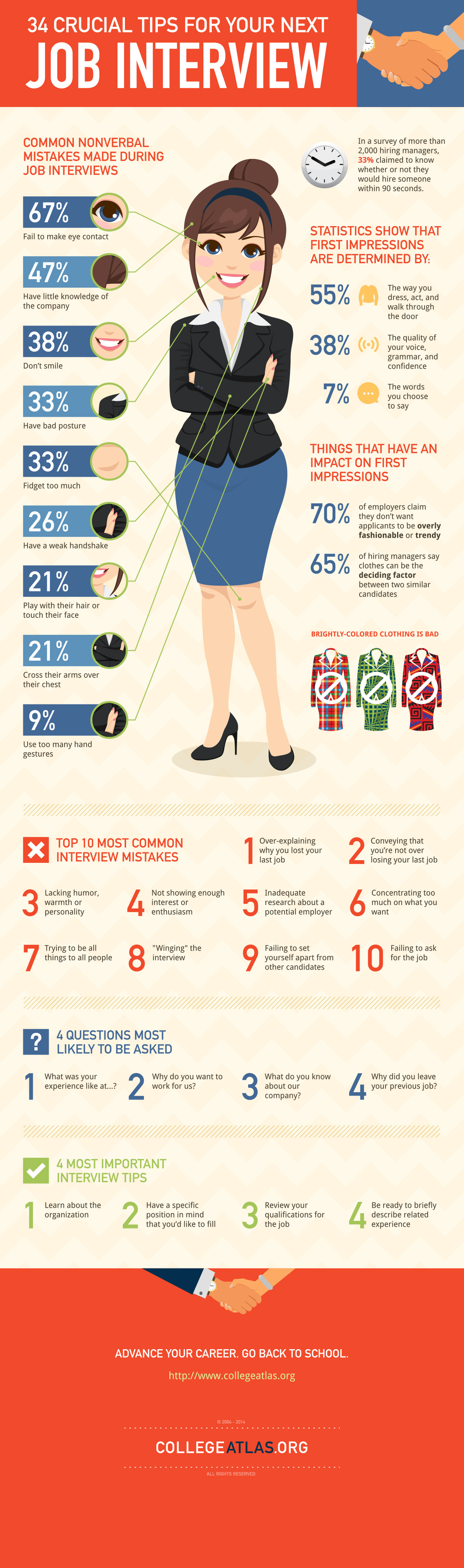
In a survey of more than 2,000 hiring managers, 33% claimed to know whether or not they would hire someone within 90 seconds. You can be one of those candidates by following these crucial interview tips.
Key Takeaways
- First impressions are formed within 90 seconds and are driven primarily by appearance and body language, not your words
- Eye contact, posture, and a confident handshake are the three nonverbal signals that most consistently influence hiring decisions
- Insufficient company research is the second most common nonverbal mistake — and it is entirely preventable
- Clothing is not just about looking nice — 65% of hiring managers say it can be the deciding factor between two equal candidates
- The interview is not over until you ask for the job — failing to close is one of the top ten most common interview mistakes
What the Data Says About First Impressions
Common nonverbal mistakes made during job interviews
- 67% fail to make eye contact
- 47% have little knowledge of the company
- 38% don’t smile
- 33% have bad posture
- 33% fidget too much
- 26% have a weak handshake
- 21% play with their hair or touch their face
- 21% cross their arms over their chest
- 9% use too many hand gestures
Statistics show that first impressions are determined by
- 55% — The way you dress, act, and walk through the door
- 38% — The quality of your voice, grammar, and confidence
- 7% — The words you choose to say
The implication is significant: the vast majority of how you are perceived in those first critical seconds has nothing to do with what you are saying. You can have excellent answers prepared and still lose the interview because of poor posture or a limp handshake.
What Your Appearance Signals
Things that have an impact on first impressions
- 70% of employers claim they don’t want applicants to be overly fashionable or trendy
- 65% of hiring managers say clothes can be the deciding factor between two similar candidates
- Brightly-colored clothing is consistently rated negatively by interviewers in professional settings
For a complete breakdown of what each piece of your outfit signals — and what to avoid — see: What Is Your Interview Attire Saying About You?
The 10 Most Common Interview Mistakes
These are the errors that most reliably cost candidates jobs — even when their underlying qualifications are strong:
- Over-explaining why you lost your last job
- Conveying that you’re not over losing your last job
- Lacking humor, warmth or personality
- Not showing enough interest or enthusiasm
- Inadequate research about the potential employer
- Concentrating too much on what you want
- Trying to be all things to all people
- “Winging” the interview without preparation
- Failing to set yourself apart from other candidates
- Failing to ask for the job
Most of these mistakes share a common root: lack of preparation and self-awareness. They are all preventable.
4 Questions Most Likely to Be Asked
Regardless of industry or role, most interviewers return to the same four core questions:
- What was your experience like at [previous employer]?
- Why do you want to work for us?
- What do you know about our company?
- Why did you leave your previous job?
Prepare specific, concise answers to all four before your interview. These are not trick questions — they are baseline filters. Weak answers here eliminate candidates before the substantive conversation even begins.
4 Most Important Interview Preparation Steps
Research from hiring professionals consistently points to four preparation steps that separate strong candidates from forgettable ones:
- Learn about the organization — not just what they do, but their recent news, values, and competitive position
- Have a specific position in mind — know exactly which role you want and why it is the right fit
- Review your qualifications against the job description — be ready to speak to every key requirement
- Be ready to briefly describe related experience — two to three tight, specific examples are more powerful than ten vague ones
What Strong Candidates Do Differently
Strong candidates are not necessarily smarter or more experienced than average candidates. They are more deliberate. They practice their answers out loud, not just in their heads. They arrive five minutes early, not right on time. They make eye contact immediately, offer a firm handshake, and sit up straight without being told. They ask one or two thoughtful questions at the end. And they close — they express genuine interest in the role and ask about next steps.
These behaviors are learnable. The data above shows exactly which signals matter most, and none of them require any special talent — just preparation and intention.
For the complete interview preparation system — research, question prep, logistics, and follow-up — see: How to Prepare for a Job Interview: The Complete Guide
Frequently Asked Questions
What nonverbal mistakes do candidates most commonly make in job interviews? The most common nonverbal mistakes are failing to make eye contact (67% of candidates), having little knowledge of the company (47%), not smiling (38%), bad posture (33%), and fidgeting too much (33%). A weak handshake and crossing your arms also register negatively with hiring managers.
How quickly do hiring managers form an opinion in an interview? Research shows that 33% of hiring managers form their hiring opinion within the first 90 seconds of meeting a candidate. First impressions are shaped 55% by appearance and body language, 38% by voice quality and confidence, and only 7% by the actual words used.
What are the most important things to do before a job interview? The four most critical pre-interview actions are researching the organization thoroughly, identifying the specific position and responsibilities, reviewing your qualifications against the job description, and preparing brief stories about relevant experience that demonstrate your value.
What are the top 10 most common interview mistakes? The top mistakes are over-explaining why you lost your last job, failing to show enthusiasm, insufficient research about the employer, concentrating on what you want rather than what you offer, trying to be all things to all people, winging the interview without preparation, and failing to ask for the job at the close.
How does clothing affect interview outcomes? Studies show that 65% of hiring managers say clothing can be the deciding factor between two similarly qualified candidates. Seventy percent of employers do not want candidates to be overly fashionable or trendy. Conservative, well-fitted professional attire consistently outperforms fashion-forward choices in interview settings.
Get 50 Interview Questions + Expert Answers — Free
Join thousands of job seekers who've used our free guide to land more interviews.
Next step for your job search
Pick one guide and keep momentum.
Jobiety Editorial Team
Our editorial team researches and tests every piece of career advice we publish. We draw on real hiring data, interviews with recruiters, and hands-on experience to give you guidance that works.